
This topic is not just important. It is the urgent truth we need to hear because people no longer care. Not about how they live, not about the process behind their actions, not even about what those actions do to their souls.
The Prophet once narrated that a man may sell his soul for the pleasures of this world, which are fleeting in nature, yet this world, in the sight of Allah, is worthless. Subhanallāh.
Reflect on that again.
What we chase so desperately… holds no weight with the One who created us.
Report has it that Malik ibn Dinar once went to the graveyard and called out:
Where are the kings? Where are the wealthy? Where are the powerful who oppressed the weak? Where are you all?
Nothing but the silence of the graveyard could be heard.
Those who walked this earth before us—the people of the 1900s, the generations before them—where are they now? Gone. Completely gone. Just like that.
And we are walking toward that same destination. So what will remain of us?
Not our bodies, they will decay. Not our wealth, it will be inherited. Not our status, it will be forgotten.
What will remain is our nafs, our soul, and the state in which we preserved it.
Because Allah is not concerned with your appearance, nor your possessions. He looks at your heart, its sincerity, its purity, its truth.
So the question is not how much we have lived… but how well we have purified what lives within us.
Every act of worship requires purification of the soul. There is no ‘small’ or ‘big’ act. What gives it weight is the state of your heart.
Across all acts of worship, the foundation is taqwā—your consciousness of Allah. That is what breathes life into what you do. So pay attention to it.
Because Allah does not accept an action simply because it is done. He accepts what is done with sincerity, with awareness, with حضور القلب—with a heart that is present before Him. Allah accepts what is pure and what is done with excellence.
The deepest concern of purification is the purification of the nafs itself—the soul. The religion of man is founded upon the purity of the soul.
The cleansing inside the heart eliminates vices like hatred, envy, and pride. The heart that is pure leads the entire body toward righteousness.
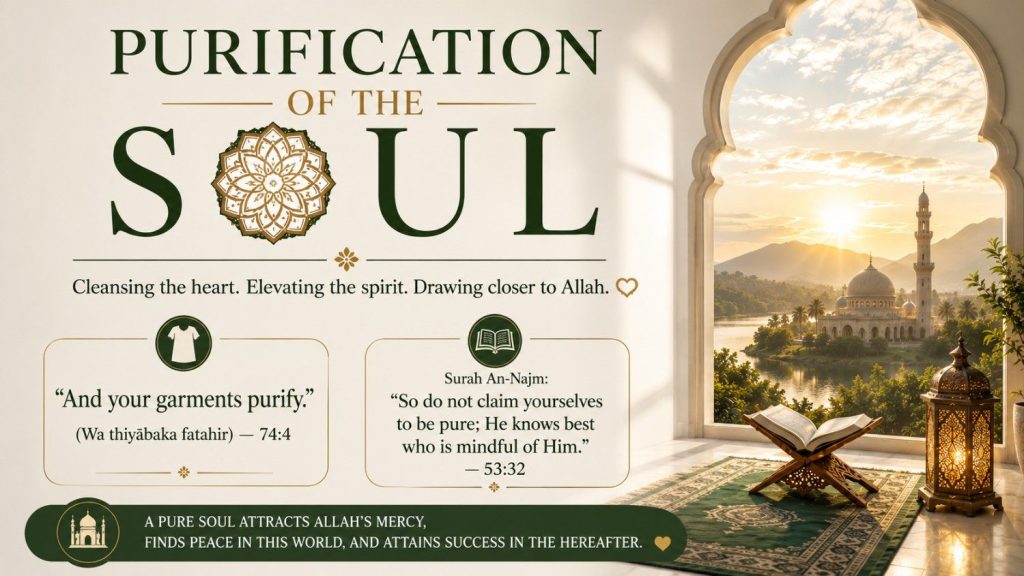
Allah has commanded the purification of the soul in many places in the Qur’an.
From Surah Al-Muddathir, where we have the direct verse on purification:
And your garments purify. (Wa thiyābaka fatahir) — 74:4
Scholars explain this in two ways:
Literal: purification of clothing (cleanliness)
Deeper: purification of the self (nafs), heart, and character
See also in Surah An-Najm:
So do not claim yourselves to be pure; He knows best who is mindful of Him. — 53:32
This is not just purifying yourself but also not assuming you are already pure. It’s a form of warning against self-righteousness.
Based on the foregoing, it is evident that success belongs to the one who purifies their souls, and doom awaits those who corrupt it.
From evil, Allah has also explained the consequences of neglecting purification. The unpurified soul will be questioned, and the person will be held accountable.
Imam Mālik and early scholars emphasized that purification of the soul is not optional—it is essential for every believer.
Even if we are engaged in acts of worship, without purification, those acts may not be accepted. Allah does not look at our forms but at our hearts.
As muslims, we must therefore strive continuously to purify our souls through sincerity, repentance, and obedience to Allah.
May Allah make the act of purifying our souls easy for us. Ameen.